Saturday, February 7, 2015
My New Poem: The Refugees
All these died in faith, without receiving the promises, but having seen them and having welcomed them from a distance, and having confessed that they were strangers and exiles on the earth. (Hebrews 11:13, NASB)
Below this world's sweet cream
Are wretched ones rare seen,
Regarded as unclean:
The Refugees.
Will ever they fit in,
Accept a hint of sin,
Since lures around them spin?
Strange Refugees.
They have no sense of style
Except for that brave smile.
'Been out of touch a while'
-- Shunned Refugees.
Rejected by their kin,
God knows where they have been:
E'en to the lion's den,
These Refugees!
Nor is the church house safe
From those who love to strafe
The odd religious waif
-- Quaint Refugees!
They're tired, wounded, sore;
In beauty, skill, quite poor.
Who has an open door
For Refugees?
They wait a 'promised land',
Not grasping what's at hand.
What has this folly fanned
In Refugees?
From what have these folk fled?
Scarce are they clothed and fed!
Are they not better dead
Than Refugees?
They ran from wrath of God;
Their sin had earned death's rod.
By ark of Christ they're awed,
Spared Refugees!
Though honored once they die
How few now hear their cry!
But there is One on high
For Refugees.
He's willed that this meek band
Inherit all earth's land,
His glory ever stand
Midst Refugees!
Till great white throne I see
With these O may I be:
The few, the faint, the free,
The Refugees!
But as it is, they desire a better country, that is, a heavenly one. Therefore God is not ashamed to be called their God; for He has prepared a city for them. Hebrews 11:16 NASB


Tuesday, February 3, 2015
From Sadistic to Saved
I found this video fascinating and wonderful for four reasons.
1. It's not often that someone takes atheism all the way to its logical outworkings: nihilism. Usually professing atheists hold on to vestiges of Christianity in their moral choices. This man stayed on the train of unbelief almost through the gates of insanity.
2. He explains things (both the lies he believed then and the truth he knows now) so clearly and concisely.
3. It gives me great joy to hear of the conversion of someone who had been so evil and sadistic. A wonderful display of the power of Jesus!
4. The way the aesthetic elements of this video are timed to correspond to the message are quite clever. What appears at first to be low quality cinematography is actually very well thought out. (Watch and see what I mean.)
1. It's not often that someone takes atheism all the way to its logical outworkings: nihilism. Usually professing atheists hold on to vestiges of Christianity in their moral choices. This man stayed on the train of unbelief almost through the gates of insanity.
2. He explains things (both the lies he believed then and the truth he knows now) so clearly and concisely.
3. It gives me great joy to hear of the conversion of someone who had been so evil and sadistic. A wonderful display of the power of Jesus!
4. The way the aesthetic elements of this video are timed to correspond to the message are quite clever. What appears at first to be low quality cinematography is actually very well thought out. (Watch and see what I mean.)
Thursday, January 29, 2015
The Forest and the Trees
If you don't see how all of Scripture points to Jesus, it dwindles down to a collection of moral principles and historical accounts. Two books I've read recently seek to show this main
message of Scripture. But they do it in very different ways. Justin Buzzard's The Big Story shows you the forest, while Todd Friel's Jesus Unmasked shows you the trees. Read just Buzzard and you'll miss a lot of beauty and depth. Read just Friel and you'll get confused. Buzzard provides the map of the national park; Friel gives you the botanical guide.
The Big Story will help you understand the 'metanarrative' (storyline) of the Bible. Others have outlined this as "Creation-Rebellion-Redemption-Consummation"; Buzzard uses the similar outline of "God-Creation-Rebellion-Rescue-Home".
Jesus Unmasked explains how Jesus is the focus of, and the gospel is portrayed in, such stories as Noah's ark, Moses' rock, the tabernacle, the bronze serpent, the sabbath, the seven festivals, to name just a few.
Here's a chart to help you see the strengths of both.
Both men are good writers and good Bible students. I consider myself fairly familiar with the Bible, but I learned significant things from both books.
I seem to have too many books and too few disciples. Consequently I find myself with no one to whom I can give either of these excellent books. Jesus Unmasked would not work for someone from another culture (too many quips that only Westerners would understand). If you, or someone you know, would be interested in a free copy of one or both of these books, please contact me.
I purchased Jesus Unmasked, but I received The Big Story for free from Moody Press in exchange for an unbiased review.
The Big Story will help you understand the 'metanarrative' (storyline) of the Bible. Others have outlined this as "Creation-Rebellion-Redemption-Consummation"; Buzzard uses the similar outline of "God-Creation-Rebellion-Rescue-Home".
Jesus Unmasked explains how Jesus is the focus of, and the gospel is portrayed in, such stories as Noah's ark, Moses' rock, the tabernacle, the bronze serpent, the sabbath, the seven festivals, to name just a few.
Here's a chart to help you see the strengths of both.
 |
 |
Highly organized and sequential
|
Highly detailed and occasionally zany
|
Quotes from trusted authors, with relatively few direct quotes from the Bible.
|
|
Careful
|
Beautiful
|
Informational (you could teach this)
|
Proclamational (you could preach this)
|
Understandable
|
Convicting
|
Focused
|
Theological rabbit trails
|
I seem to have too many books and too few disciples. Consequently I find myself with no one to whom I can give either of these excellent books. Jesus Unmasked would not work for someone from another culture (too many quips that only Westerners would understand). If you, or someone you know, would be interested in a free copy of one or both of these books, please contact me.
I purchased Jesus Unmasked, but I received The Big Story for free from Moody Press in exchange for an unbiased review.
Monday, January 12, 2015
A Lament for a Fallen Christian Leader
If you've been a Christian for a while, you have probably experienced the pain of watching the fall of a spiritual leader you once admired. I have written this poem in hopes of helping us process the emotions and respond appropriately.
How could the mighty fall
from combing skies,
and give up all
to claw the earth with cries?
How could a shepherd boy
become a Saul
and then destroy
the flock which was his all?
How could he have no friend
to stop the train
before the end?
Did his friends think like Cain?
How could such silver rules,
such pedigree,
such splendid schools
produce such infamy?
How could such honey jet
from lips that kiss
the dirt and yet
think nothing is amiss?
How could a sinner get
forgiveness free
and turn to spit
disgrace upon the Tree?
How could God save by him
who would be lost,
for some strange whim
as castaway be tossed?
How could God not deter
from evil's lurk
His messenger
And finish His good work?
How could I think so much
of clay and build
my dreams on such
who, like me, had God killed?
Is there yet chance that he,
though Demas now,
a Mark may be,
again to keep his vow?
How can I hope I've got
no risk of fall?
Why might I not,
in love with world, leave Paul?
May toppled towers be
dread means of grace
like walls, keep me
entranced with just Your face.
Thursday, January 8, 2015
Counseling the Hard Cases
A new mother imagining throwing her baby against the wall.  A man terrified of driving on odd-numbered streets. A woman with dissociative identity disorder running down the middle of the street in the rain, barefoot. Is the Bible sufficient to help people like these? What about the woman who goes into hysterical shrieking when she enters the kitchen due to flashbacks of childhood abuse? We tend to think that people with severe problems like these need treatment deeper than the Bible discusses.
The book Counseling the Hard Cases is a wonderfully encouraging demonstration that God is not dead, and His Word is not inadequate. It contains ten true stories of people with all of the above problems, and many more, who found hope, peace, life, and lasting change through the life, death, and resurrection of Jesus. The ten stories are told by ten different biblical counselors, who explain in detail the problems the people had, and how the Bible spoke to each of them.
I have taken over 60 hours of training in biblical counseling and have read a number of books on it, including three by Jay Adams. But I can honestly say that this book was more helpful to me than any of them. It is detailed enough that when you're done you feel like you could help someone with similar problems, yet non-technical enough that you don't get bored or brain-fogged.
More than filling your head with knowledge of counseling, this book repeatedly points you toward worship as you see how God rescues people even from the most horrible problems you can imagine.
Every pastor and church elder should own and read this book (why not bless yours by giving them copies?). I also would recommend it for any layperson who has psychological problems or who wants to help someone who does. The printed book is rather expensive but the Kindle version is reasonable.
I got this book for free, but as a gift from a friend, not the publisher.
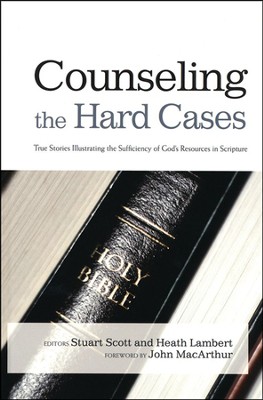 A man terrified of driving on odd-numbered streets. A woman with dissociative identity disorder running down the middle of the street in the rain, barefoot. Is the Bible sufficient to help people like these? What about the woman who goes into hysterical shrieking when she enters the kitchen due to flashbacks of childhood abuse? We tend to think that people with severe problems like these need treatment deeper than the Bible discusses.
The book Counseling the Hard Cases is a wonderfully encouraging demonstration that God is not dead, and His Word is not inadequate. It contains ten true stories of people with all of the above problems, and many more, who found hope, peace, life, and lasting change through the life, death, and resurrection of Jesus. The ten stories are told by ten different biblical counselors, who explain in detail the problems the people had, and how the Bible spoke to each of them.
I have taken over 60 hours of training in biblical counseling and have read a number of books on it, including three by Jay Adams. But I can honestly say that this book was more helpful to me than any of them. It is detailed enough that when you're done you feel like you could help someone with similar problems, yet non-technical enough that you don't get bored or brain-fogged.
More than filling your head with knowledge of counseling, this book repeatedly points you toward worship as you see how God rescues people even from the most horrible problems you can imagine.
Every pastor and church elder should own and read this book (why not bless yours by giving them copies?). I also would recommend it for any layperson who has psychological problems or who wants to help someone who does. The printed book is rather expensive but the Kindle version is reasonable.
I got this book for free, but as a gift from a friend, not the publisher.
Sunday, January 4, 2015
The Joy of ESL
Did you ever notice that immigrants often have some of the same characteristics necessary to become a follower of Jesus?
- Willingness to leave family members and all that is familiar (Luke 14:25-27)
- Courage to embrace risk or loss in exchange for a greater reward (Matthew 13:44-46)
- Recognition that they are aliens in a foreign culture (1 Peter 2:11-12)
- Willingness to work harder, for less money, than natives (1 Corinthians 9:12)
 |
| One of our students |
Wednesday, December 31, 2014
Reconciling Calvinists and Arminians?
The interplay between God's sovereignty and human responsibility is one of the most difficult aspects of theology to talk about accurately. It's also one of the most important. How can God permit evil without also being guilty of evil? If God has predetermined everything in advance, doesn't that mean He is responsible for our sinful choices? And why should we bother to do anything? Que sera, sera! But if God doesn't control everyone's choices, doesn't that mean our lives could be derailed (or even ended) by the sinful (or merely stupid) decisions of people around us? Better build stronger walls! These positions have been debated heavily and hotly by philosophers and theologians for centuries, and the debates are still active today.

There are really two aspects to the ongoing controversy. First, there is the debate between determinism and libertarianism, which relate to the big picture of God's sovereignty and human responsibility in all areas of life. Then there is the debate between Calvinism and Arminianism, which focuses specifically on God's sovereignty and human responsibility in the salvation of humans from sin and God's wrath. It is a subset of the bigger debate.
Pastor and seminary professor Randy Alcorn has addressed both of these debates in his new book, hand in Hand. (And no, that was not a capitalization mistake.) Although I think he made a few blunders along the way, his book points readers in the right direction.
Perhaps the most noteworthy characteristic of this book is that it is irenic, not polemic. In other words, it's peaceful. Alcorn strongly tries to pull readers from both sides toward the middle, encouraging them to lay aside the invectives and assumptions they have about the other side. While clearly putting both Hyper-Calvinism and open theism outside the bounds of Christian orthodoxy, he seeks to show that mainstream Calvinism and Arminianism can both be orthodox.
Alcorn also works hard to base his theology on Scripture alone, rather than a logical framework. This is why he believes only four point of the five points of Calvinism. He knows that this makes his theology less cohesive, but he prefers this to believing something he doesn't see in Scripture. I applaud his intention even while I disagree with him in his understanding of some Scriptures. I love where he says, "The best theological label is 'Berean'".
In addition to bringing together a number of Scriptures relevant to this debate, hand in Hand also includes a number of quotes from other recognized Christian thinkers and teachers throughout history. For me, this was perhaps the most helpful part of the book because while I had studied most of the Scriptures before, I had not read many other writings about them. (The only other books I have read on this subject are Norman Geisler's Chosen But Free and James White's rebuttal, The Potter's Freedom, which I recommend as a companion to hand to Hand.)
Alcorn has studied this issue far more carefully than I have. So I was, frankly, surprised to find a few things that seemed like obvious errors, things that Alcorn himself may actually disagree with if he had thought about them more.
1. He attempts to find an analogies that will help explain how God's choices and human choices can both be real and meaningful. He borrows Tozer's ship analogy (pages 152-153) and Strong and Fisk's fishbowl analogy (page 178). The idea is that the ship captain controls the big picture (speed, destination, route) while the passengers have free choices within the ship (they can watch a movie, swim, eat, sleep, etc.). Similarly, the fishbowl owner controls where the bowl is placed, how many fish are in it, what food they get, but leaves the fish free to swim as they will within the limitations of the bowl. These analogies are both dangerously flawed, and I'm surprised Alcorn didn't see it. The ship captain and fishbowl owner are unable to protect their passengers and fish from every contingency. A passenger might kill another, and a fish might jump out and die. The captain and owner do not even know what the actions of the passengers and fish will be, much less have a way to bring good out of every choice the passengers and fish make. A god like this is not very comforting when tragedy strikes.
In the end, we must acknowledge that we do not and cannot understand how God's sovereignty and human responsibility coexist. We just know with confidence that both do. As with the Trinity (one God, three persons), we can see and describe what the Bible teaches on the subject, but we cannot fully explain or understand it, and no analogy will prove helpful.
2. He repeats the often-asserted notion that God gave humans the ability to choose evil because otherwise we would be robots, and our love would be meaningless (pages 144-145). The obvious problem with that is that Christians will be unable to sin in heaven, yet we will not be robots and our love and worship will still be very meaningful. Alcorn asserts this very thing (pages 146-148) and yet fails to note that it contradicts what he just said. Rather than saying that God gave us the ability to choose evil so that we would not be robots, the Bible seems to indicate that God gave it to us so that He could display His incredible patience and mercy toward us when we did choose evil (Romans 9:19-24). God could have made us free, loving, non-robotic beings incapable of sin from the get-go, but He chose to make us capable of sin while on earth, so that He could display His wrath and His mercy.
3. He quotes C. S. Lewis along these same lines, but with an extra kink:
As I said before, man's freedom to choose evil is not God's tribute to the value of human self-determinism, but to the value of His own glory. The extra problem in this quote was the reference to God taking a risk. Only open theism teaches that God can take risks. I'm positive Alcorn doesn't believe in open theism (he spends an entire chapter in the book dismantling it) so I'm surprised he didn't catch that.
4. In his attempt to calm the warring parties, Alcorn skirts some of the stickier issues, such as particular redemption and double predestination. Thus a person new to the debate could come away thinking there is less difference between the two sides than actually exists.
5. Hand in Hand also does not discuss the ways consistent Arminians and Calvinists live differently. In other words, how do the differences in their beliefs result in differences in their behaviors? This book could lead one to think it is it all theoretical and makes little difference at street level. But especially when it comes to counseling, evangelism and prayer, the differences do have significant implications.
So, with these weaknesses, why I am I still recommending this book? (Since he's a four point Calvinist, I'm going to give him a four star rating!) Mainly because there are too many angry Arminians and Cage-Stage Calvinists out there. My first few exposures to the doctrines of grace (as I prefer to call the five points of Calvinism) were mostly negative snippets from snarky Calvinists. But when I heard them explained in a peaceful way, similar to the way they are presented in this book, I realized how biblical and beautiful they are. I hope that this book will have the same effect for you.
I received this book for free from WaterBrook Multnomah in exchange for an unbiased review.
There are really two aspects to the ongoing controversy. First, there is the debate between determinism and libertarianism, which relate to the big picture of God's sovereignty and human responsibility in all areas of life. Then there is the debate between Calvinism and Arminianism, which focuses specifically on God's sovereignty and human responsibility in the salvation of humans from sin and God's wrath. It is a subset of the bigger debate.
Pastor and seminary professor Randy Alcorn has addressed both of these debates in his new book, hand in Hand. (And no, that was not a capitalization mistake.) Although I think he made a few blunders along the way, his book points readers in the right direction.
Perhaps the most noteworthy characteristic of this book is that it is irenic, not polemic. In other words, it's peaceful. Alcorn strongly tries to pull readers from both sides toward the middle, encouraging them to lay aside the invectives and assumptions they have about the other side. While clearly putting both Hyper-Calvinism and open theism outside the bounds of Christian orthodoxy, he seeks to show that mainstream Calvinism and Arminianism can both be orthodox.
Alcorn also works hard to base his theology on Scripture alone, rather than a logical framework. This is why he believes only four point of the five points of Calvinism. He knows that this makes his theology less cohesive, but he prefers this to believing something he doesn't see in Scripture. I applaud his intention even while I disagree with him in his understanding of some Scriptures. I love where he says, "The best theological label is 'Berean'".
In addition to bringing together a number of Scriptures relevant to this debate, hand in Hand also includes a number of quotes from other recognized Christian thinkers and teachers throughout history. For me, this was perhaps the most helpful part of the book because while I had studied most of the Scriptures before, I had not read many other writings about them. (The only other books I have read on this subject are Norman Geisler's Chosen But Free and James White's rebuttal, The Potter's Freedom, which I recommend as a companion to hand to Hand.)
Alcorn has studied this issue far more carefully than I have. So I was, frankly, surprised to find a few things that seemed like obvious errors, things that Alcorn himself may actually disagree with if he had thought about them more.
1. He attempts to find an analogies that will help explain how God's choices and human choices can both be real and meaningful. He borrows Tozer's ship analogy (pages 152-153) and Strong and Fisk's fishbowl analogy (page 178). The idea is that the ship captain controls the big picture (speed, destination, route) while the passengers have free choices within the ship (they can watch a movie, swim, eat, sleep, etc.). Similarly, the fishbowl owner controls where the bowl is placed, how many fish are in it, what food they get, but leaves the fish free to swim as they will within the limitations of the bowl. These analogies are both dangerously flawed, and I'm surprised Alcorn didn't see it. The ship captain and fishbowl owner are unable to protect their passengers and fish from every contingency. A passenger might kill another, and a fish might jump out and die. The captain and owner do not even know what the actions of the passengers and fish will be, much less have a way to bring good out of every choice the passengers and fish make. A god like this is not very comforting when tragedy strikes.
In the end, we must acknowledge that we do not and cannot understand how God's sovereignty and human responsibility coexist. We just know with confidence that both do. As with the Trinity (one God, three persons), we can see and describe what the Bible teaches on the subject, but we cannot fully explain or understand it, and no analogy will prove helpful.
2. He repeats the often-asserted notion that God gave humans the ability to choose evil because otherwise we would be robots, and our love would be meaningless (pages 144-145). The obvious problem with that is that Christians will be unable to sin in heaven, yet we will not be robots and our love and worship will still be very meaningful. Alcorn asserts this very thing (pages 146-148) and yet fails to note that it contradicts what he just said. Rather than saying that God gave us the ability to choose evil so that we would not be robots, the Bible seems to indicate that God gave it to us so that He could display His incredible patience and mercy toward us when we did choose evil (Romans 9:19-24). God could have made us free, loving, non-robotic beings incapable of sin from the get-go, but He chose to make us capable of sin while on earth, so that He could display His wrath and His mercy.
3. He quotes C. S. Lewis along these same lines, but with an extra kink:
Of course God knew what would happen if they {Adam and Eve} used their freedom the wrong way: apparently He thought it worth the risk. ... If God thinks this state of war in the universe a price worth paying for free will—that is, for making a live world in which creatures can do real good or harm and something of real importance can happen, instead of a toy world which only moves when He pulls the strings—then we may take it it is worth paying. (Page 56; quoting from Part 18 of Mere Christianity)
As I said before, man's freedom to choose evil is not God's tribute to the value of human self-determinism, but to the value of His own glory. The extra problem in this quote was the reference to God taking a risk. Only open theism teaches that God can take risks. I'm positive Alcorn doesn't believe in open theism (he spends an entire chapter in the book dismantling it) so I'm surprised he didn't catch that.
4. In his attempt to calm the warring parties, Alcorn skirts some of the stickier issues, such as particular redemption and double predestination. Thus a person new to the debate could come away thinking there is less difference between the two sides than actually exists.
5. Hand in Hand also does not discuss the ways consistent Arminians and Calvinists live differently. In other words, how do the differences in their beliefs result in differences in their behaviors? This book could lead one to think it is it all theoretical and makes little difference at street level. But especially when it comes to counseling, evangelism and prayer, the differences do have significant implications.
So, with these weaknesses, why I am I still recommending this book? (Since he's a four point Calvinist, I'm going to give him a four star rating!) Mainly because there are too many angry Arminians and Cage-Stage Calvinists out there. My first few exposures to the doctrines of grace (as I prefer to call the five points of Calvinism) were mostly negative snippets from snarky Calvinists. But when I heard them explained in a peaceful way, similar to the way they are presented in this book, I realized how biblical and beautiful they are. I hope that this book will have the same effect for you.
I received this book for free from WaterBrook Multnomah in exchange for an unbiased review.
Subscribe to:
Posts (Atom)